
By Dr. Emmanuel Rwothongeyo
The sight of young medical interns in white coats being arrested and taken before Buganda Road Court—and later reportedly remanded to Luzira Prison—for protesting over unpaid allowances should concern every Ugandan who believes the country’s health system deserves better.
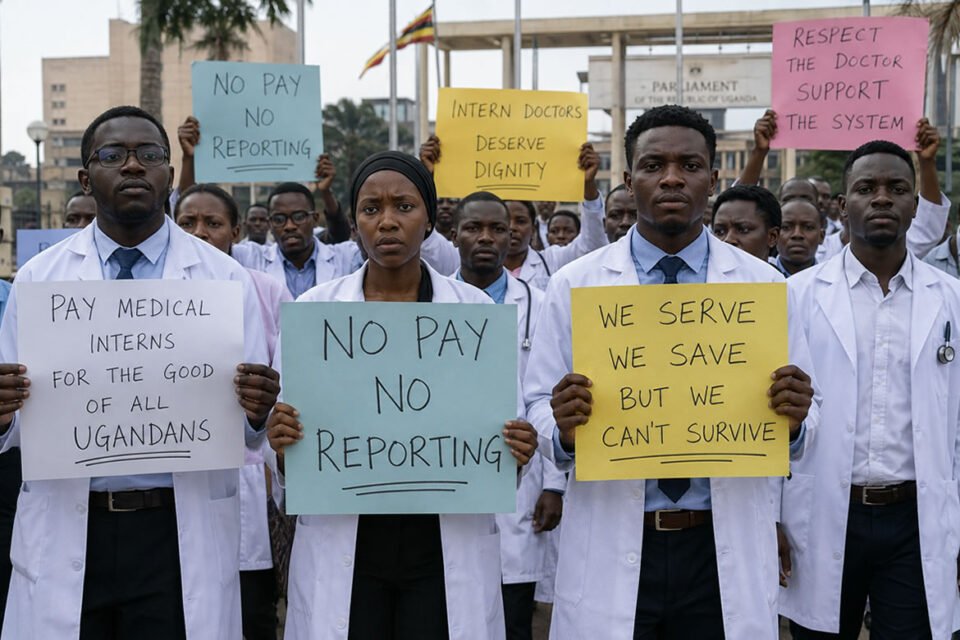
On 12 August 2026, eight medical interns, including Dr. Kagahe Jamadah and Silver Ssengonga, reportedly stood along Parliamentary Avenue carrying placards reading “NO PAY, NO REPORTING” and “PAY MEDICAL INTERNS FOR THE GOOD OF ALL UGANDANS.”
Their protest was reportedly met with arrests on allegations related to causing inconvenience to traffic.
But behind the legal argument lies a much bigger question: Why has a dispute over the welfare of medical interns reached the point of arrests, court appearances and prison?
These are young doctors at the beginning of their professional careers. They are not asking for luxury. They are asking for the means to survive while completing a mandatory stage of medical training and service.
A crisis that did not begin yesterday
The current dispute is not simply about one protest or one group of interns. It reflects a deeper disagreement over how Uganda defines, funds and values medical internship.
The National Education and Training for Health (NETH) policy reportedly reclassified internship primarily as a continuation of training rather than employment. That distinction has significant consequences for how interns are facilitated and remunerated.
The allowances paid to interns have also changed over time, with figures that were once around Shs 2.5 million per month in 2021 later falling substantially, while questions remain over how different categories of interns are expected to survive during the mandatory internship period.
For many young doctors, internship means long shifts, night calls, emergency cases and responsibility for patients in facilities that are already struggling with staffing shortages.
Whatever the legal classification of internship may be, the reality inside many hospitals is difficult to ignore: interns contribute to patient care.
That reality deserves to be reflected in policy.
The government must listen, not simply issue deadlines
The Uganda Medical Association (UMA) and the Federation of Uganda Medical Interns have called for a number of measures, including a more realistic monthly allowance, deployment of all eligible interns, payment of outstanding arrears and meaningful consultation over the implementation of the NETH policy.
Government officials, including Health Minister Dr. Chris Baryomunsi, have urged interns to report by the set deadlines and warned that failure to do so could have consequences for their placements. Government has also maintained that consultations are ongoing.
That position, however, does not resolve the underlying problem.
When young doctors say they cannot afford to report for mandatory service without adequate facilitation, the answer cannot simply be: report or lose your place.
Government has a responsibility to explain the financial constraints, present the available options and engage the affected professionals in good faith.
And if there are legitimate budgetary limitations, those limitations should be placed openly on the table.
Interns are part of the health workforce
There is a tendency to describe medical interns as students and, therefore, to overlook the contribution they make to Uganda’s health facilities.
But ask the patients and health workers in a busy district hospital what happens when clinical staff are stretched beyond capacity.
Interns often work alongside doctors, nurses, clinical officers and other health professionals in managing patients, conducting rounds, responding to emergencies and supporting the delivery of services.
This does not mean interns should be treated simply as employees. It means policymakers should recognise the practical reality of their contribution when designing a system of training and facilitation.
A health system cannot continually expand medical training while failing to adequately support the young professionals entering it.
Arrests are not a substitute for dialogue
Perhaps the most troubling part of this episode is the decision to treat a professional and labour-related grievance primarily as a matter of public order.
If the interns’ demands were unreasonable, government had—and still has—the opportunity to demonstrate why.
It could sit with the interns, UMA, medical schools and professional councils. It could present the budget numbers. It could propose a phased payment structure. It could negotiate.
That is what mature institutions do.
Arresting peaceful protesters may restore traffic flow for a few hours. It does not solve the health workforce crisis.
Nor does it answer the fundamental question of how young doctors are expected to complete a mandatory year of internship when they cannot meet basic living and transport costs.
There are solutions
The dispute does not have to remain a confrontation between government and medical interns.
Several practical steps could help move the country forward.
 First, government should consider suspending or reviewing the most contentious provisions of the NETH policy and conduct a transparent, time-bound consultation involving UMA, the Federation of Uganda Medical Interns, medical schools, professional councils and other relevant stakeholders.
Second, government should establish a realistic and sustainable monthly facilitation package for interns. If the proposed Shs 4 million figure cannot be implemented immediately, a transparent phased approach could be considered, backed by a clearly identified funding mechanism.
Third, outstanding legitimate arrears should be addressed. Asking young professionals to report for service while unresolved payment obligations remain outstanding only deepens mistrust.
Fourth, all eligible interns should have a clear pathway to deployment at accredited facilities. Any consequences for interns who participated in the protest should be handled fairly and through due process rather than through blanket threats.
Finally, government should look beyond the monthly allowance. Interns working in hard-to-reach areas need practical support, including accommodation or transport facilitation where possible, adequate protective equipment and proper systems for managing occupational exposure and other workplace risks.
Uganda cannot afford to manufacture its own brain drain
Uganda has invested heavily in expanding medical education and producing more doctors.
But producing doctors is only one part of building a strong health system.
The country must also create an environment in which those doctors can transition from university into professional practice with dignity and adequate support.
Otherwise, Uganda risks creating a frustrating cycle: train more health professionals, fail to support them at the point of entry into service, watch morale deteriorate, and eventually lose some of the country’s best-trained professionals to private practice or opportunities abroad.
That is not merely a problem for doctors.
Patients ultimately pay the price.
When health workers are exhausted, demoralised or insufficiently supported, the quality and availability of care can suffer.
This is a choice about priorities
The government has difficult choices to make. Resources are limited, competing demands are many, and no health budget can satisfy every need immediately.
But leadership is about priorities.
If Uganda can train thousands of medical professionals, it must also ask how those professionals will be supported when they reach the hospitals where they are needed most.
The medical interns are not asking to be treated as privileged citizens.
They are asking to be heard.
They are asking for clarity on their future.
They are asking for the facilitation necessary to complete a mandatory stage of their professional journey.
And they are asking government to engage them before making decisions that directly affect their livelihoods and careers.
Arresting white coats will not heal a sick health system.
Dialogue might.
Policy reform might.
Adequate investment might.
And treating health workers with dignity certainly cannot hurt.
Uganda’s health system needs more than new policies and more medical graduates. It needs a workforce that feels valued, supported and willing to stay.
The government should therefore move beyond confrontation, reopen meaningful negotiations and find a sustainable solution to the internship crisis.
Because ultimately, this is not only about the interns.
It is about the patients they are being trained to serve.
Disclaimer: This is an opinion article. Allegations, claims and figures referenced in the article should be understood in the context of the ongoing public debate and official positions of the relevant stakeholders.

1 comment
thanks Emma for your concern